The Light Changed at Three
You noticed it first in the shadows. The runs you had been carving all morning lost their definition, the moguls flattening into suggestion, the treeline going blue. Your legs had been asking to stop since two. Your partner had been asking since one. But you pushed for one more, one more, one more, because the mountain was good.
You took the last run slower than the others. Not because you were tired, though you were. Because something in the afternoon light made you want to pay attention to what the mountain looked like from the middle of it. This frozen body of rock and snow and engineered pleasure. You had been on it all day. The morning runs would blur together in memory. This last one you would remember frame by frame.
At the base, you unclicked your bindings and stood there for a second, skis in hand, breathing hard, face raw from wind. The mountain was still right there. You could see the line you had just taken, already being erased by the groomer. In twelve hours you would be back on it. But first, the evening.
Movement 1: Boots in the Hallway
At Crystal Peak Lodge in Breckenridge, the mountain does not let you go gradually. It releases you all at once. You skied to the door. That is not a figure of speech. Peak 7 delivered you to the building's base, and you walked inside with snow still on your shoulders. Goggles pushed up into your hair. The cold came off you like a scent. The hallway was warm and your boots were loud on the floor. You left them by the door the way you leave shoes at a temple. What came next required a different body.
The jetted tub was already there, the way it had been there all day while you forgot about it, while the mountain was the only thing that mattered. You turned the water on before you took off your base layer. You could hear it filling while you peeled off the wool and the polyester and the second skin of sweat that a ski day leaves on you. The balcony door was open two inches and the cold air came through that gap like a blade. It met the steam from the tub. For a moment the room held both temperatures at once. You got in before it was full. You watched the water rise around you while Breckenridge turned on its lights outside, the town arranging itself for evening, the mountain going dark above it.
Twenty minutes ago you had been on that mountain. Now the mountain was a silhouette. Same place, different relationship. You were no longer on it. You were watching it. And the watching felt like the second half of something the skiing had started.
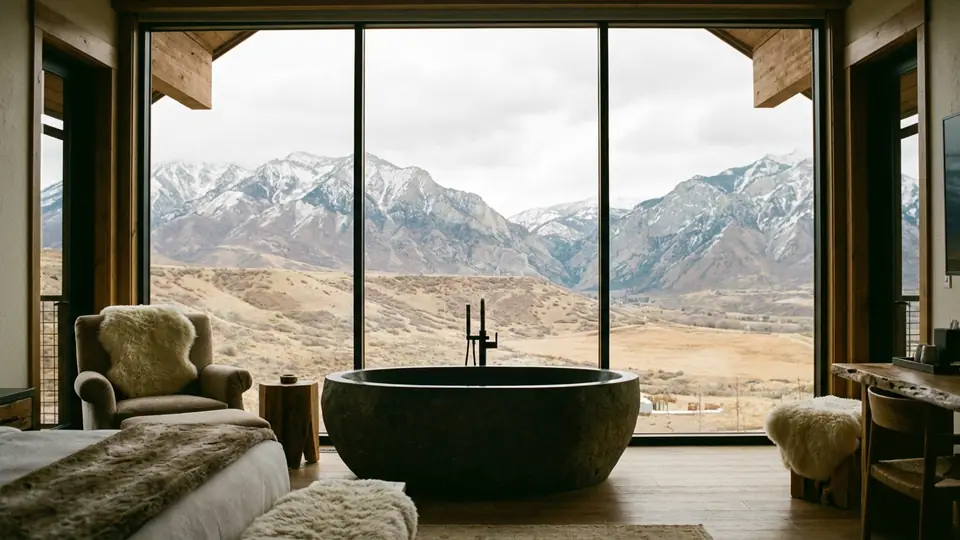
At St. Regis Deer Valley, the same collapse of distance happened at a different pitch. Ski-in, ski-out. The mountain ended and the room began and the freestanding tub was waiting in a suite where floor-to-ceiling windows made the whole wall into a screen playing the Wasatch Range at dusk. You changed temperature, nothing else. Hot water loosened what the mountain had tightened.
Movement 2: The Town Between
Not every ski evening begins in the room. At The Wentworth in Jackson, New Hampshire, the tub waited, but you made it wait.
You drove back from Wildcat or Attitash or Black Mountain with the heater on high, the car smelling like wet wool, the radio playing something you would forget. Jackson earned your time before it gave you your room. You parked and walked. The streetlights were on already. In January in New Hampshire, dark comes at four thirty and the town adjusts. You found the place with candles in the windows and a menu chalked on a board. You sat across from your partner and ordered something warm. Soup. Or a pot pie. Something that belonged to winter.
The Wentworth understood delay. It had been standing in Jackson since 1869, white clapboard and green shutters. The kind of building that looks built by people who understood something about winter evenings. The pace is not fast. Your room had a freestanding modern tub and the window looked out at the kind of darkness that only exists in towns with three thousand people. You filled the tub after dinner, after the walk, after the cold had re-entered your body and reminded you what you were warming up from. The delay made the water feel different. You had earned it with patience, not just with skiing.
In Whitefish, Montana, the Lodge at Whitefish Lake offered a different version of the same delay. The drive back from Whitefish Mountain Resort crossed a town built around a lake that freezes in winter, and the lakefront property put the soaking tub in a room where the water outside and the water inside rhymed. You stopped for a drink on Central Avenue first. Whitefish had not yet learned to be embarrassed about being a ski town. The bars still belonged to the people who lived there. The tub came later.
Movement 3: The First Heat
At Sundance Mountain Resort, Robert Redford built a place where the body changes state on a balcony. The resort sits on the slopes of Mount Timpanogos in a canyon that Redford bought in 1969 because he believed beautiful places deserved to be kept rather than developed. Fifty years later the canyon has proved him right. Your cabin had wood finishes and art on the walls, real art, not hotel art, pieces from the colony of artists and writers that Sundance has housed for decades. The jetted tub was on the balcony. You stepped outside in the cold and got in fast. The water was almost too hot against skin still remembering the mountain. Timpanogos was right there in the dark, massive, lunar, its snow glowing faintly in whatever light the sky was giving.
The sound was what stayed. Not silence, because mountains are never silent in winter. Wind moving across rock. The creak of trees holding snow. The jet of the tub, mechanical and rhythmic. You stayed in longer than you meant to. Your partner's hair froze at the tips where it touched the air above the waterline. You both noticed and neither of you moved to go inside. The mountain watched you back.
At Big Sky, the outdoor hot tub at a ski-in/ski-out cabin put Montana's cold directly on your shoulders while the rest of you was submerged. No balcony railing between you and the night. The sky was the thing. No light pollution for miles, just the cold scatter of stars and the silhouette of Lone Mountain and the steam from the water rising into air so cold it vanished almost immediately. Summer from the neck down. January from the collarbone up.
The Whiteface Lodge in Lake Placid gave the same split a different accent. An Adirondack great camp, log and stone, the private hot tub on a suite balcony facing Whiteface Mountain. The sound was different here. Not Montana silence. The wind through old-growth spruce has a specific pitch, low and constant, the sound of a mountain that has been standing in the same weather for longer than anyone has been skiing it. You could hear the ice on the lake shifting, a deep occasional crack that sounded geological. The water held you. The mountain held still.
Movement 4: The Room After
The tub is not the end of the evening. It is the turn. What comes after is quieter, slower, a body that has been heated and is now cooling at its own pace, finding a temperature between the mountain's cold and the water's warmth that belongs only to the room.
At the Omni Mount Washington Resort in Bretton Woods, the room after the tub felt like a century of winter guests agreeing on what an evening should be. The building is a white palace at the base of the Presidential Range, built in 1902, a place so confident in its own grandeur that it does not need to mention it. Your suite had a clawfoot tub, the old kind, the kind that stands on feet and holds heat the way cast iron holds heat. Slowly and completely. But the tub was only the prelude. The evening was the room itself: the fireplace going, the windows showing the Presidentials in moonlight, the specific quiet of a building that has three hundred rooms and enough history to absorb the sound of all of them.
You put on the robe. It had been hanging in the same spot since 1902, or felt like it. You stood at the window. Mount Washington was out there, the highest peak in the Northeast, the place with the worst weather on Earth, and from this window it looked gentle. Domestic. A mountain you could live with. The wind was doing something violent on the summit. You knew that. But from here the mountain was just a shape against a sky full of stars. You were warm. The evening had delivered what the skiing could not. Stillness.
Sun Valley Lodge in Idaho held a different kind of history. The lodge opened in 1936, the first destination ski resort in America. Hemingway wrote here and Gary Cooper skied here. The ghosts sat lightly in the wood, the way old timber holds the memory of hands. The freestanding tub in the room was modern, the renovation had seen to that, but the building's bones were old. The evening had the quality of a film set between takes. Quiet. Expectant. You could hear the bowling alley two floors down, a faint rumble of pins, and it made the building feel alive in a way that made your room feel more private by contrast.
Movement 5: The Morning You Chose the Room
You woke before your partner. The light was different. Winter mornings in the mountains come in silver, not gold. You could hear the lift. A faint mechanical hum that started at exactly the same time it starts every morning, the mountain opening for business, the first chairs carrying the people who set alarms.
You did not set an alarm.
At Adventure Suites in North Conway, New Hampshire, the morning was not grand. It was better than grand. It was funny. The room had a theme. Adventure Suites does that. Yours had a heart-shaped jacuzzi you had laughed about at check-in. You spent two hours in it the night before. Not because it was beautiful. Because it was warm and ridiculous and your partner was in it, and the snow outside the window made everything inside feel like a cocoon built by someone with a sense of humor.
The mountain was five miles away. Cranmore, or Attitash, or Wildcat, whichever one you had picked, was running its lifts and grooming its trails and doing everything a mountain does to convince you to come back. You could see the ridge from the window. It would still be there at ten, at eleven, at noon.
You stayed in bed. Your partner's breathing was slow and even. The heart-shaped tub was absurd and beautiful in the morning light, porcelain curves catching the silver that came through the curtains. You thought about first chair. You thought about the packed-snow sound of morning groomers and the empty runs and the cold air that wakes you up the way coffee never quite does.
You did not move.
A warm room. A sleeping partner. A mountain outside the window that looked, for the first time since you arrived, like it could wait.
The lift hummed. The mountain opened. You pulled the blanket higher.
Not yet.