The Gesture
You set it face-down on the railing. You do not think about it. Your hand just does it, the way your hand finds a light switch in a dark room. The screen goes against the wood, and condensation is already forming on the glass because the steam from the tub has been drifting over everything for the last ten minutes. The case is wet. The notifications underneath are wet. You are lowering yourself into 103-degree water and the railing is the last thing you see before your shoulders go under. The wood is rough-cut cedar, rain-darkened, and the grain holds the droplets instead of shedding them. Your thumbs have nothing to do. They float.
The Sound of Water
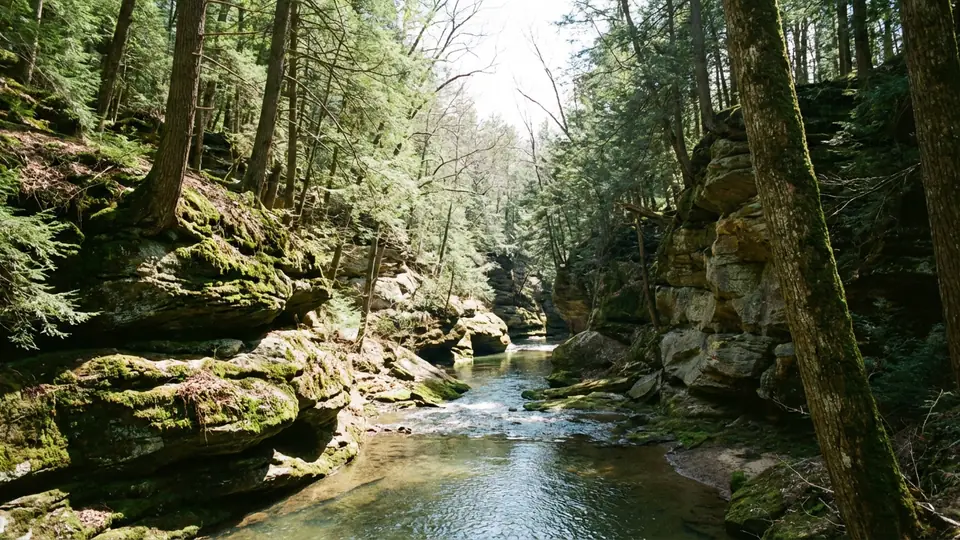
In spring, the Little Pigeon River runs fast and cold outside River Cottage Psalm 23 in Pigeon Forge. A steady white noise that sits in the register just below conversation. You hear it before you see it. The hot tub sits on a deck that overhangs the bank. The mist from the rapids mixes with the steam from the water you are sitting in. Two temperatures of moisture on your skin at once. The river is maybe fifteen feet below, moving left to right if you are facing the tree line, and the sound it makes is not a babble. It is a hiss. A sustained, consonant-heavy exhale that fills the space where your thoughts usually queue up. You stop composing the email you were drafting in your head. There is no room for it. The frequency is occupied.
The current is the timekeeper here. It does not pause. It does not buffer. You watch a leaf enter the frame on the left and leave on the right, and when the next one comes, you realize you have been sitting still for twenty minutes.
At Getaway Cabins in South Bloomingville, the water is different. Hocking Hills does not give you a creek beside the deck. It gives you the gorge. The falls at Old Man's Cave drop into sandstone bowls that amplify the sound into something closer to a low roar, audible from the cabin's tub through the hemlock canopy. It is deeper, more percussive. Where the Pigeon Forge creek erases thought, the Hocking Hills water replaces it with a single sustained tone, like a chord held on an organ. You feel it in your sternum.
The Ridgeline
From the deck of Glade Mountain Top Retreat in Clyde, North Carolina, you are above the weather. The Blue Ridge spreads below you in every direction, and on mornings when the fog has not burned off, you are looking down at the tops of clouds. The tub sits at the edge of a clearing, and the view is not framed by trees. It is open. Your eyes do not stop at a tree line or a neighboring roof. They go until the haze takes over, and the haze is fifty miles out.
This is what elevation does. It gives your eyes nothing to land on, so they keep moving. The ridges layer from green to blue to grey to white, each one fainter than the last. Your brain does something it almost never does in a city. It processes depth. Real depth. The kind that takes seconds to scan. The muscles behind your eyes soften. You did not know they were tense.
Sunset Cabin in Canaan Heights, West Virginia, offers the Appalachian version of the same effect, compressed and more intimate. The ridges here are closer, darker, thicker with hardwood. At dusk they stack in silhouette. Five ridges, each a shade darker than the one in front of it, until the last one is indistinguishable from the sky. You are in the tub and the water is the same temperature as the air was six hours ago. The ridges are dissolving. You let them.
Neither of you has spoken in a while, and the silence is not empty.
The Fire
At Redwood in Ruidoso, New Mexico, the ponderosa pines rise straight up from the deck like columns in a cathedral somebody forgot to roof. The hot tub is outdoor, and beside it, fire tablets throw a low, orange light that moves. It flickers across the water's surface, across the steam, across the face of the person facing you. Fire emits light that is irregular, warm, alive. Your eyes track it the way they track a bird. Without deciding to.
The pines smell like vanilla and butterscotch. That is not a metaphor. Ponderosa bark, when the sun has been on it all day, releases a scent that is closer to a bakery than a forest. By evening the air has cooled enough that the scent pools at deck level, mixing with the cedar of the tub and the mineral tang of the water. You are warm from the water and warm from the fire and the two warmths are not the same. The water holds you. The fire watches you.
Modern Harpers Ferry Cabin offers fire in a different register. The covered deck contains the warmth like a room without walls. The trees press in close, and the fire pit's glow does not scatter into open sky. It bounces off the wood ceiling, the railing, the tub's surface, building a pocket of amber light surrounded by Appalachian dark. It is smaller, closer, more like a living room than a cathedral.
The Dark
The hilltop outside Millersburg, Ohio, is farm country. Amish country. The nearest streetlight is a long drive away, and at Secluded Cabin Getaway, the deck sits at the top of a cleared hill with nothing between you and whatever the sky is doing. On a clear night in rural Holmes County, the Milky Way is a river, not a smudge.
You see the band of it. Dense enough to cast a shadow if you knew where to look. You are in the tub and the water is dark because there is no porch light, no landscape lighting, no neighbor's motion sensor. The only light is stellar, and it is enough to see the steam rising off the surface and your own hands resting on the tub's edge. Your pupils have opened as wide as they go. The sky has detail. Texture. Grain. You are looking at it the way you look at a photograph, scanning from quadrant to quadrant, and each quadrant has something you missed the first time.
Lydia Mountain Cabins in Stanardsville sits in the foothills of the Shenandoah, where the mountain dark is different from the farm dark. It is not open. It is enclosed. The tree canopy blocks the periphery and opens a column of sky directly above the tub, like looking up through a well. The stars you see are fewer but sharper, framed by black branches. The silence is total except for whatever the wind decides to do with the leaves.
The Cold
Breckenridge sits at 9,600 feet. In January, the air on the deck of Breckenridge Cabin is fifteen degrees. Maybe ten. Your breath is visible. The railing has a half-inch of snow on it that nobody has brushed off, and it is accumulating in real time, a slow white line thickening while you watch. You are in 104-degree water. The water is an event at this temperature differential.
Your shoulders are submerged and your collarbones are the border. Below: heat so thorough it reaches your bones within a minute. Above: air so cold it turns your exhale solid. The border between the two is a two-inch strip of skin where everything is happening at once. You sink lower and the border moves to your chin. You sit up and it hits your chest and the cold is a slap and you sink again. The mountains are there, the Continental Divide is somewhere in the middle distance, but you are not looking at the view. You are managing the boundary between two temperatures, and it is more engaging than anything you have done all week.
In Gatlinburg, LL Honeymoon offers the winter Smokies version: softer cold, mid-thirties, the kind that makes the tub necessary rather than dramatic. Snow sits on the rhododendron leaves outside the deck. The water feels like rescue instead of spectacle. You do not negotiate the boundary. You surrender to it.
The Person
Go back to whichever deck held you longest. The one where you read the description and felt your shoulders drop half an inch. You are there again. Same tub. Same water temperature. Same sound, or same silence, or same fire. But this time, look across.
There is a person in the water with you. Their hair is wet at the ends from the steam. Their eyes are closed. Or they are tracing the same ridgeline you were tracing. Or they are looking at you. Their hands are resting on the surface, palms down, the way yours are. You have not spoken in a while, and the silence is not empty. It is the kind that happens when two people are held by the same water and the same hour and neither one needs to narrate it.
The creek got your attention. The ridgeline held your eyes. The fire moved the light. The dark opened your pupils. The cold made the water urgent. But the person across from you is why it lasted. The whole weekend. Not just the first hour, when the novelty of silence does the work for you. The second morning. The third soak. The drive home, when the car is quiet in a way that means something got repaired, and the person in the passenger seat is watching the same road you are.
##
Two people in water. The railing, the steam, the first grey light of a morning neither of them set an alarm for. No glow except the sky. You stop looking.