A Dolphin at the Dock
You are sitting in a hot tub on a private balcony in Fort Myers Beach, watching the marina go pink with the last of the sun, when a bottlenose dolphin surfaces twenty feet from the railing. It rolls once, breathes, and slides back under. The water you are sitting in did not change. The tub did not change. But the evening just became something you will describe to friends for years, and the reason has nothing to do with jets or tile work or the shape of the basin.
The word "unusual," when it comes to jacuzzi suites, almost never refers to the tub. It refers to what the tub is doing. What it frames, what it contradicts, what it removes. Somewhere in Idaho Falls, a freestanding jacuzzi sits in the center of a room designed to look like ancient Egypt, and the whole suite orbits the water. Somewhere on the California coast, a standard freestanding model faces a window where sea otters float past. Somewhere in North Carolina, a hot tub sits on the deck of a campground cabin, and it is the last thing you expected and the best part of the trip.
Four hotels. Four completely different ideas about what a tub can do to a room, a view, an evening. None of them are unusual because of their shape.
The Spectacle
You check in at Destinations Inn in Idaho Falls and the woman at the desk asks which suite you booked, though she already knows, because everyone who books the Egyptian room wants to talk about the Egyptian room.
The door opens and the suite is not a hotel room that references Egypt. It is a set. Marble floors. Columns that rise to a painted ceiling. A freestanding jacuzzi positioned in the center of the space like a ceremonial basin, which, in the logic of this room, it sort of is. The water catches the light from windows that run from the floor to the painted ceiling and throws it against stone. You are not in Idaho Falls anymore. You are in a fever dream of the Nile Delta. Someone loved it enough to carve every detail by hand.
The jacuzzi at Destinations Inn is not an amenity tucked into the bathroom. It is the room's centerpiece, its reason, the thing the architecture orbits. You do not use this tub to unwind after a day of sightseeing. You use it to enter a world that exists only inside these four walls. The themed suites here, each one a different civilization, a different fantasy, are artisan-crafted down to the grout, and the tub is always the altar.
No restraint, no minimalist good taste, no Scandinavian parsimony. The design says: this is a spectacle, and you are in it. The steam rising from the jacuzzi catches the glow of the marble, and for a few hours you are a person who bathes in a room that looks like a palace. You do not need to be embarrassed about enjoying it.
The Egyptian suite is unusual in the most literal sense. It does not look like anything you have seen in any other hotel, anywhere. But what makes it worth remembering is not the marble or the columns. It is the permission the room grants you to take pleasure seriously. To fill the tub, to lie back in warm water, to look up at a painted ceiling and feel, without irony, that this is exactly as much as an evening should be.
What this suite does with its tub is not luxury. It is editing.
The Frame
The freestanding tub in the suite at Monterey Plaza Hotel & Spa is, by itself, unremarkable. White. Clean-lined. The kind of tub you would find in any upscale renovation. If you photographed it against a blank wall, you would scroll past it.
But the tub is not against a blank wall. It faces the bay.
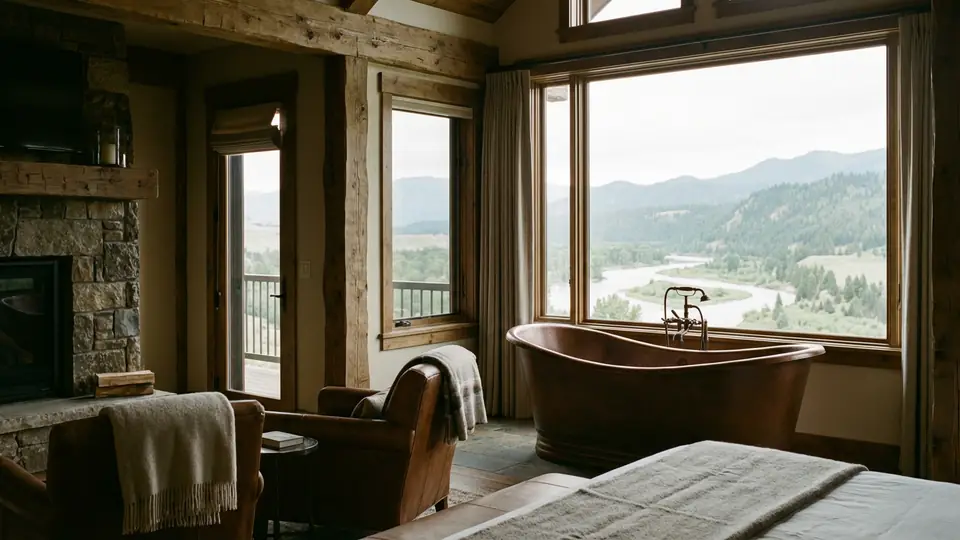
Monterey Plaza sits directly on the water at Cannery Row, and in certain suites the tub is positioned so that when you settle into it, your eye line drops to the level of the Pacific. Not above it, looking down like a tourist. Level with it. The ocean fills the window like a painting that moves. The things that move through it, sea otters floating on their backs in the kelp beds, pelicans folding themselves into dives, are not scenery. They are company.
The tub at Destinations Inn commands attention. The tub at Monterey Plaza surrenders it. The design move is not what the tub looks like. It is where the tub sits. Someone decided that this basin, in this room, should face this particular angle of the Monterey Bay. That single decision turned an ordinary bath into something you think about months later.
You fill the tub in the late afternoon. The light on the water is the color of weak tea. A sea otter rolls onto its back fifty yards out, cracking something against its chest. You watch it from inside warm water, through glass, and the distance between you and the animal is intimate without being intrusive. You are a guest of the bay. The tub made you one.
Cannery Row, outside, is doing what Cannery Row does. Tourists walk the sidewalks. Restaurants fill up. But from inside the tub, the human noise recedes and the ocean stays. The window frames it. The tub positions you to receive it. The design is not in the porcelain. It is in the angle, the height, the placement. Someone understood that a tub is a place where you stop moving, and what you see when you stop moving is the entire point.
What this suite does with its tub is not decoration. It is editing.
The Contradiction
You pull into Broad River Campground in Mooresboro, North Carolina, and the first thing you see is a sign for firewood. The second thing you see is a camp store. The third thing you see is a cabin with a private hot tub on the deck. Your brain stalls for a moment because those two ideas, campground and private jacuzzi, do not belong in the same sentence.
And yet. The wood-finished cabin sits above the Broad River, and the hot tub on its deck is not apologetic about being there. It is not hidden behind a privacy screen or dressed up to look like something other than what it is. It is a hot tub. At a campground. On a deck overlooking a river where people were probably fishing this morning.
The hot tub on the deck does not feel out of place. It feels like the campground's best idea. There is no marble here. No themed decor. The view is trees, river, sky, and whatever bird just landed on the railing. The sounds are water over rocks, someone's campfire crackling two sites over, the occasional screen door. You are not at a resort. You are at a campground that decided, at some point, that a hot tub on the deck would be a good idea. That decision turned out to be one of the best small ideas in American hospitality.
What makes this unusual is not any design choice. It is the absence of one. Nobody hired an architect. Nobody consulted a mood board. Somebody put a hot tub on a deck by a river and let the river do the rest. You sink into the water at dusk. The Broad River catches the last copper light. Smoke from a campfire somewhere downstream reaches you in thin threads. You are, by every metric that hotels use, in a modest accommodation. And you are having one of the best evenings of the year.
The comedy of it is part of the pleasure. You packed hiking boots and bug spray and a cooler. Now you are sitting in a hot tub watching the river go dark, and the person next to you is laughing because neither of you expected this from a campground. The gap between expectation and experience is where the magic lives. Every luxury hotel tries to exceed expectations by adding more. Broad River exceeds them by being exactly what it is, a campground, and then catching you off guard with one generous, well-placed tub.
The Absence
The road to Horizon Hill outside Berkeley Springs, West Virginia, narrows until the trees close in from both sides and you lose cell signal. This is not a dramatic loss. It is a relief. By the time you reach the log cabin, you have already begun to forget what you were going to check on your phone.
The cabin is wood and glass. Floor-to-ceiling windows face the forest, and the forest faces back, offering nothing but itself. Tulip poplars, oaks, the sound of something small moving through underbrush. Inside, a wood fireplace. The furniture is simple. The light is whatever the sky decides. On the terrace, a hot tub, uncovered, looking out at trees that go on until they become hills that go on until they become the Appalachian sky.
There is no themed design. There is no ocean. There is no river, no marina, no dock where a dolphin might surface. There is a hot tub on a wooden terrace surrounded by trees. The design statement, if you can call it that, is the removal of everything else.
You fill the tub. You get in. The water is hot and the air is cool and the combination produces steam that rises into branches. Nobody can see you. Nobody knows you are here. The nearest indication that other humans exist is a wisp of woodsmoke from a chimney you cannot locate. The forest absorbs sound. Your breathing slows. The fireplace through the glass doors throws an orange pulse against the cabin walls. The woods outside the windows are going blue-black. You are, for the first time in weeks or months, unreachable.
Not escape, which implies something you return to, but erasure. For the hours you are in this water, on this terrace, you are not performing the role of guest. You are not being hosted. There is no staff, no lobby, no room service, no concierge. There is a cabin and a tub and a forest and a fire. The design genius is that someone built this and then left you alone with it.
Of the four hotels in this piece, this one is the hardest to photograph. A tub, trees, steam. It would make a poor Instagram post. But weeks later, you will remember the temperature of the air against your shoulders. The sound of the fire through the glass. You will remember looking up and seeing more stars than you thought were available.
The most unusual design, it turns out, is no design at all. Just the decision to put warm water in a quiet place and take everything else away.
Steam on Glass
You are back in a hotel bathroom. Somewhere ordinary. A business trip, a family visit, a weekend that did not require research. The tub is white, rectangular, built into the wall. A chrome faucet, a drain, a bath mat. You turn on the hot water and steam fogs the mirror above the sink.
You look at the window. It faces a parking lot, or an air shaft, or another building's windows. You notice the glass. You notice what is on the other side. You have never thought about this before, what a tub faces, what it frames, what it erases or reveals.
The tub fills. The water is warm. The window fogs.
You know what is missing.