You know the moment before you get in. Your robe is off. The air finds every part of you at once. It is nineteen degrees, or twelve, or six. It does not matter yet, because your body only knows one thing: this is wrong. Then your foot breaks the surface and the water is 104 and the argument between your skin and the air reverses so fast your chest tightens. You sink to your shoulders. Steam rolls off the water in a sheet, and for a few seconds you can see the exact line where warm ends and cold begins. It is right there, an inch above your collarbones, visible as smoke.
This is the part everyone agrees on. Hot water, cold air, the shock, the settle. But what nobody tells you is that the cold on the other side of that steam is not one thing. A Colorado blizzard is not a frozen Maine lake is not a Utah canyon at dusk. The winter you choose changes the water. It changes what you hear, what you see when you look up, what the silence sounds like, how long you stay in. It changes what you remember.
Four American winters. Four kinds of cold. The tub is the constant. Everything else moves.
The Blizzard Deck
The snow in Breckenridge starts falling before you are ready for it. Not a dusting. A serious, vertical, windless accumulation that fills boot prints in twenty minutes and turns the porch railing into a white ledge three inches thick. By late afternoon the mountain has closed, the ski boots are off, and the altitude fatigue has settled into your thighs like wet cement. The world outside the cabin is white and grey and still.
The hot tub at Breckenridge Cabin sits on a wood deck fifteen feet from the tree line. At 9,600 feet, the air is thin and dry. The cold does not creep. It announces itself. You step out in a towel and the moisture on your shoulders freezes before you reach the tub edge. The water, when you lower yourself in, feels hotter than it is. That is the altitude. That is the contrast. Your body has been cold and tired and working all day, and the heat enters your muscles like a conversation you have been waiting to have.
Snow falls into the tub. This is the detail nobody mentions in the brochures. It lands on the surface and vanishes. It lands on your hair and stays. You are accumulating winter on your head while your body is submerged in heat, and the absurdity of it is part of the pleasure. The trees, lodgepole pines mostly, hold snow on their branches in careful horizontal lines. There is no wind. The silence at this altitude, in this snow, is not the absence of sound. It is a pressure. A soft, physical weight on the air that makes your own breathing louder.
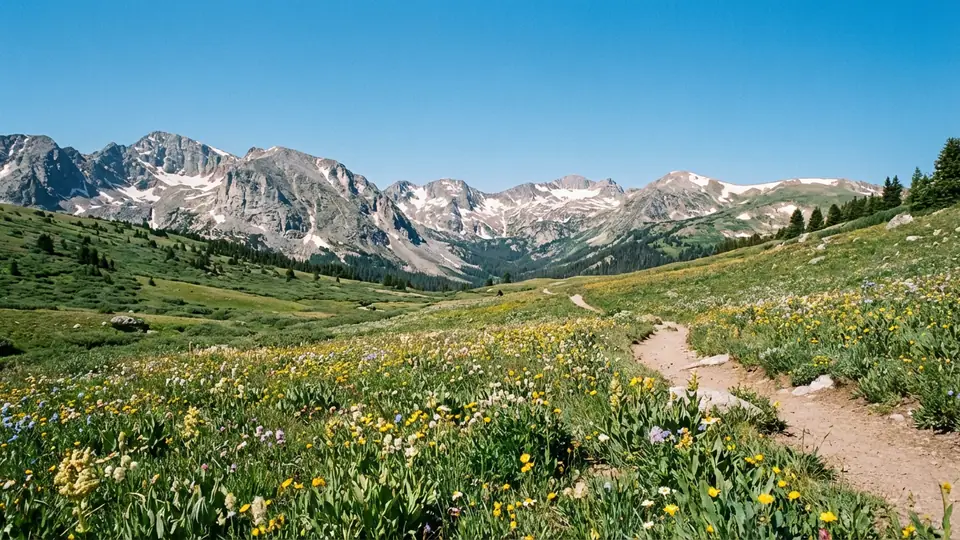
Fifteen miles north, the cabins around Estes Park offer the same altitude, the same dry cold, but the view opens. Rocky Mountain National Park begins where the tree line ends. On clear mornings after a storm, the peaks are so white against a blue so deep it looks manufactured. Heavenly Pines puts its hot tub on a private balcony facing that view. Around seven on a clear morning, the sun sits low enough to turn the upper ridges pink while the valley below holds its shadow. The distance between you and that color feels like something you could reach out and close.
But Breckenridge in a snowfall is the version that stays. The exhilaration of the day, the skiing or the trails or the walk through town in proper cold, has burned off by evening. What remains is a body that wants nothing but heat and stillness. The tub gives you both. The blizzard gives you permission to want nothing else.
The Auteur's Canyon
The cold in the Wasatch Range has a direction. It moves through the canyon below Mount Timpanogos like water through a channel, arriving from the northeast in a steady, focused current that hits the balcony at Sundance Mountain Resort and keeps hitting it. This is not the still, accumulating cold of a Colorado snowfall. This is architectural cold. It has edges.
Robert Redford bought this land in 1969, and what he built here is less a resort than a conviction. The buildings are wood and stone and glass, set into the mountainside as if they grew there. In the afternoon you can throw pottery in a studio where the wheel faces the canyon. A screening room shows independent films most evenings. The dining room serves elk from the valley and bread from a baker twelve miles south. Everything at Sundance is specific. Everything has been chosen.
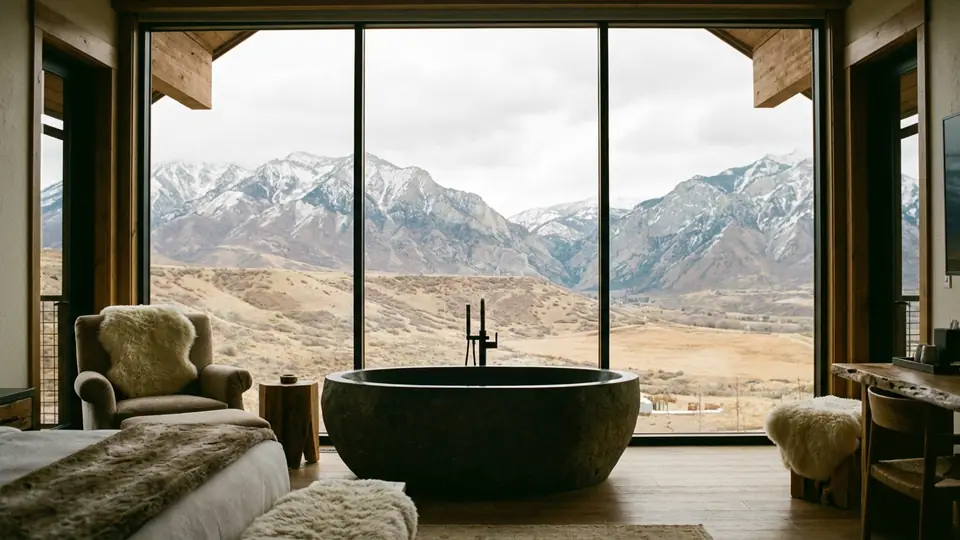
The view is Timpanogos: 11,752 feet of limestone and snow, close enough that you can see where the rock face goes vertical, where the ice clings in pale blue ribbons to the north-facing walls. At dusk the mountain turns the color of a bruise, purple and grey, and the canyon wind drops its temperature three degrees in ten minutes. You feel it on your face, the one part of you above the waterline. Your cheeks go cold. Your jaw tightens. Below your chin, the jetted water keeps its argument going, and the division between the two temperatures is so precise you could draw it.
What Sundance does to winter is frame it. The other properties in this piece let you experience cold as weather. Here, cold is composition. The angle of the balcony is not accidental. The sightline to Timpanogos is not accidental. Your towel hangs on a rail made from reclaimed barn timber, collecting frost while you soak. Even the rail has a provenance.
The canyon cold is real, sharp enough to make your eyes water if you face it directly. But the frame around it, the wood, the stone, the low lighting from the cabin behind you, the faint smell of juniper from somewhere below the balcony, turns the cold into a scene. You are watching winter perform.
The shift from western mountains to the eastern kind happens in the air before it happens on the ground. The cold gets heavier. Wetter. The sky lowers and turns the color of old pewter, and the snow, when it falls, falls sideways. The properties get smaller. The landscapes compress. The word "mountain" still applies, but the scale changes. You can see the other side.
The Frozen Lake
Tripp Lake freezes in late December most years. By mid-January it is six miles of grey ice under grey sky, and the silence over the surface is the kind that makes you aware of your own heartbeat. Wolf Cove Inn sits on the eastern shore, a clapboard building with dark green shutters and a porch that faces the frozen water. In summer this is a swimming lake, a kayaking lake. In winter it is a painting that does not move.
The whirlpool here is not on a deck. It is in the room. A jetted tub built for two, set near a window that faces the lake, with a wood-burning fireplace six feet away. The geometry of this is important: you are in hot water, looking through glass at a frozen landscape, with fire at your back. Three temperatures in one room. The water is hot on your skin. The glass is cold to the touch if you reach for it. The fire sends dry warmth across your shoulders when you sit up. Your body does not settle on a single temperature. It lives in all three.
This is the quietest winter on this list. The morning meal arrives, something with blueberries and local cream, and that is the first event. The lake is the second. A walk along the shore in proper boots, the kind of walk where you do not talk much because the cold is too serious for casual conversation, is the third. By afternoon the light is already going. New England winter light leaves early and without ceremony, and by four o'clock the trees along the lakeshore are black shapes against a sky that has given up on color.
Ninety miles northwest, Rabbit Hill Inn in Lower Waterford, Vermont, offers the same season transposed to a river valley. The Connecticut River replaces the lake. The freestanding tub sits near a fireplace in a room with no television; the innkeepers removed them on purpose. The morning is a full breakfast, the evening is a three-course dinner, and between those two anchors the day belongs entirely to you and to the cold outside the window. The river does not freeze solid like Tripp Lake. It moves under a skin of ice, and on quiet mornings you can hear it.
What New England winter does to the hot tub experience is compress it. The world outside is not vast and dramatic. It is close, grey, bare-branched, and deeply still. New England cold is bone-damp and will-sapping. It makes the indoors feel like a victory, and the warmth of the water matters more for it. You do not soak to recover from an active day. You soak because the soaking is the day.
The River Steam
Ouray sits at the bottom of a canyon so narrow that the town has nowhere to sprawl. The San Juan Mountains rise on three sides. The Uncompahgre River runs through the middle. In winter the canyon walls funnel cold air downward until the town feels like the inside of a refrigerator with the door left open. It is mountain cold again, Colorado cold, but the canyon traps moisture the high country sheds. Your breath hangs in the air and stays.
But here is what makes Ouray different from every other winter tub destination in the country: the ground is warm. Natural hot springs feed pools and tubs throughout the town and surrounding canyon. The Uncompahgre itself runs near geothermal vents. On cold mornings, steam rises from the river in columns that catch the early light and turn gold. The landscape is doing what you are doing. It is holding heat against cold, releasing steam into frozen air. The visual effect is a valley that appears to be breathing.
The hot tub at Ouray Riverside Resort sits along the river, and the sound of water over rock is constant. Not loud. A continuous, low-register conversation between the river and the stones it has been polishing for ten thousand years. The tub is outdoor, private, positioned so the canyon wall rises in front of you and the river runs beside you. On a January evening the steam from your tub merges with the steam from the river. You cannot tell where one ends and the other begins. You are not the only warm thing in a cold world. You are part of a system.
This is the winter that answers the question differently than the others. In Breckenridge, the cold is what you earn the right to sit in after a hard day. At Sundance, the cold is the composition, the beautiful frame. In Maine, the cold is the reason to compress your world to a room and a fire and a person. In Ouray, the cold is a participant. The hot springs have been negotiating with it for millennia, long before anyone built a tub or a cabin or a resort. You are joining a conversation that started without you and will continue after you leave.
The minerals in the water leave a faint smell on your skin, sulfur and iron, that lasts for hours. The smell is faint, mineral, geological. It is the smell of the earth doing exactly what your body is doing in that tub: finding warmth, holding it, letting the cold be cold.
The Walk Back
You do not choose the hotel. Not first. You choose the winter. Snow falling into your hair. Canyon wind sharpening your jaw. The grey stillness of a frozen lake. The impossible fact of a warm river in a cold valley. The hotel is where you go to meet the winter you picked. The tub is how you sit with it.
The moment that stays is never the soak itself. It is the after. You stand. The water sheets off your body and the air finds you. Every nerve fires at once, a whole-body recognition that the cold has been waiting, patient, the whole time you were warm. The towel is where you left it, cold now, and you wrap it and walk. Three steps, maybe five. The door handle is freezing under your wet hand. You push it open.
Inside is dry warmth. A different kind. Radiator warmth, or fireplace warmth, or the warmth of a room that has been holding its temperature while you were gone. Your skin adjusts in layers: feet first on the wood floor, then arms, then the back of your neck where the last of the water is evaporating. The cold follows you inside for exactly one breath, then the door clicks shut and it stays where it belongs.
Tomorrow morning you will choose it again. You will open that door, cross those same steps, lower yourself into the water, and let the steam rise. The winter will be there. It was always the point.