The Elevator
The floor numbers are climbing and you are watching them. Twelve. Fourteen. Sixteen. The elevator is glass on one side and you catch the parking garage giving way to concrete, then to sky, but you are watching the numbers because the numbers are the point. Beside you, someone is holding a keycard and a bottle of something cold. Neither of you is talking. You have not seen the room.
The hallway, when the doors open, is the first clue. The carpet is thicker up here, or maybe the sound has changed. Your footsteps do not land the way they did in the lobby. The corridor is long and there are fewer doors than you expected, spaced far apart. At the end of it a window shows nothing but sky and a thin line of rooftops. You find your number. You slide the card. The door opens to a room where the curtains are drawn and the air conditioning hums at a frequency so low it feels like silence.
You do not know what is out there yet.
The balcony door is behind the curtains. You can feel it: the faintest draft at the hem, the sense that the room extends beyond what you are seeing. But the tub, the city, the height you paid for, all of it is behind fabric right now. You set the bottle down. You walk to the window.
You pull the curtain.
Floor Eight
The city is right there.
Not below you, not spread out beneath you like the photos promised. Right there. At eye level, almost. The building across the street has offices on this floor and one of them still has its lights on, a desk lamp casting a yellow circle on a stack of papers no one will read tonight. You can see the papers. You can almost read them.
You open the balcony door and the city walks in. Not gently. A car horn, specific and impatient, three blocks east. Bass from somewhere below, a bar or a restaurant with its doors open to the sidewalk. The smell of charcoal and garlic, which means someone is grilling, and it is close, and tomorrow you might find the place and eat there.
The tub is round and not large. Two people fit if they know each other well enough to negotiate legs. You run the water. It fills slowly, and while it fills you lean on the railing and look down.
Eight floors is not high. Eight floors is a treehouse. You can see faces. Not clearly, not well enough to describe them later, but well enough to know they are faces: a man on a phone, pausing at a crosswalk; a woman in heels walking faster than the people around her, cutting diagonals through a crowd that moves in straight lines. You can track individuals. You can invent their evenings. He is late for something. She is not late; she just walks like that.
The water is ready. You step in. The heat is immediate and complete, the kind that makes your shoulders drop before your brain decides to relax. From the water, seated, the railing cuts the view at a new angle. You lose the sidewalk. You keep the rooftops, the lit windows, the sky between buildings.
From inside the tub, the city is a show you did not buy tickets for. It does not know you are watching. A siren starts somewhere to the south and you both turn your heads to track it. The sound bends through streets, bounces off facades, gets closer, veers west, fades. You look at each other. You know exactly which street it turned on. You have walked that street.
Eight floors lifts you just enough to see pattern in the chaos, but not so far that the chaos becomes abstract. You are still part of the city. You are just not on its schedule. The couple on the sidewalk below has somewhere to be. You are in hot water on a Tuesday, watching them go there, and the distance between their evening and yours is exactly eight floors: close enough to feel the connection, far enough to feel the absence of obligation.
The person beside you points at something. A restaurant patio across the street, strung with lights, where a waiter is carrying a plate of something that steams. You both watch the plate arrive at its table. You discuss whether you are hungry. You are not, but the conversation is the point: you are narrating the city to each other, building an evening that no one below has looked up to notice.
Rising
Another lobby. Another elevator. The numbers on the panel are climbing past where you were before.
The hallway on twenty is different from the hallway on eight. Not better. Quieter, in a way that feels structural. The window at the end of the corridor does not show rooftops. It shows sky and, if you look down at the right angle, the tops of trees that line a boulevard you can no longer hear. Your ears have adjusted. There is a faint pressure, not painful, just present, a reminder that the air up here is not the air down there.
You open the door. The curtains are open this time.
Floor Twenty
Your altitude above the city has changed, and the effect is a different city. The one you saw from floor eight, the one with faces and sirens and garlic smoke, has been replaced by something flatter, wider, and quieter. The streets are still there but they have become lines. The cars are still moving but they have become light, short dashes of white and red sliding along a grid that, from here, looks intentional. Designed. From the sidewalk, a city feels improvised. From the twentieth floor, it looks like someone planned the whole thing.
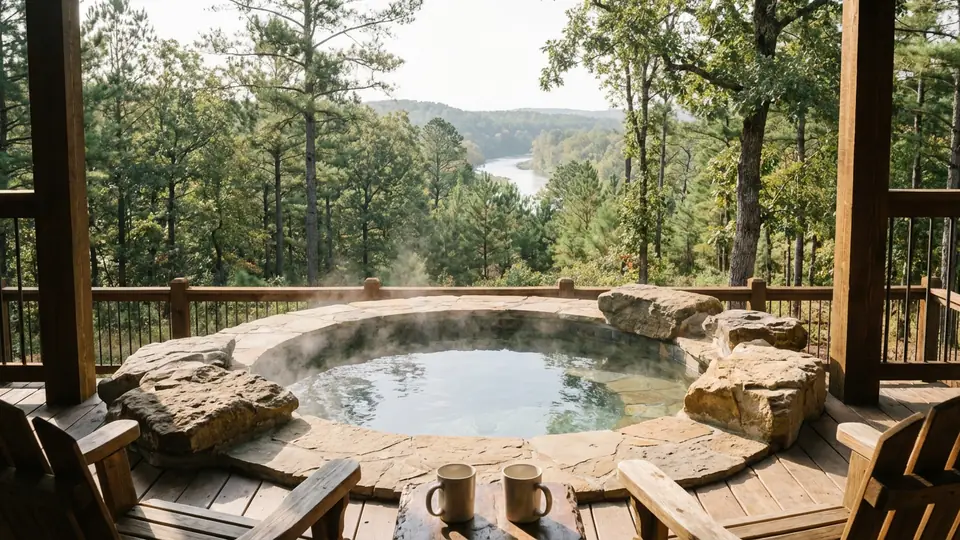
The terrace is deeper here. The spout arcs the water in a way that someone thought about. The sound of running water is the loudest thing on the terrace, which tells you something about what twenty floors does to a city's volume. The restaurant you could smell from floor eight does not exist up here. Nothing smells like anything except concrete cooling after a warm day and, faintly, the mineral scent of the water itself.
You are already in. The heat is the same. The water does not know what floor it is on. But you do, because the moment you settle and look out, the city has become a screensaver. Beautiful, slow-moving, requiring nothing from you. A bus makes a turn that takes longer than it should, tracing an arc you can see in its entirety from start to finish. On the sidewalk, you would see a bus turning. From here, you see geometry.
At floor eight, you pointed and described. You tracked individuals, invented stories, argued about which restaurant was grilling. Here, there is nothing to point at. There are patterns, not people. The conversation does not die; it changes direction. It turns inward, toward the two of you, because the city has stopped offering material.
She says something about the weather. You see what she means. From here, you can watch a weather system approach: a band of cloud moving in from the west, visible as a slow darkening that eats the skyline building by building. You watch it come. You feel the temperature on the terrace drop one degree, then two, and the differential between the heated water and the cooling air tightens around your shoulders like a second skin. At street level, weather arrives. At twenty floors, you watch it travel.
The lights of a city seen from the twentieth floor pulse. They brighten and dim with a rhythm that corresponds to nothing you can identify. Traffic signals cycle. Signs flicker. Windows illuminate and go dark as someone walks through a room. The pulse has no message. It has texture.
In the tub, you have stopped talking. Not because something is wrong but because the city at this altitude does not require language. Floor eight was a conversation piece. Floor twenty is ambient. The water is dissolving the day into warmth and slow breathing, and the city is being beautiful in a way that asks nothing of you. Your hand finds the other hand under the water. Neither of you mentions it.
Rising Again
The last elevator requires a keycard against a sensor before the top buttons illuminate. The numbers above thirty are printed in a different font, or maybe that is your imagination. What is not imagined: the hallway up here has four doors. Maybe five. The corridor is shorter because the rooms behind those doors are not. The silence is total and specific. It is the silence of thick walls, heavy doors, and nothing outside the windows but wind.
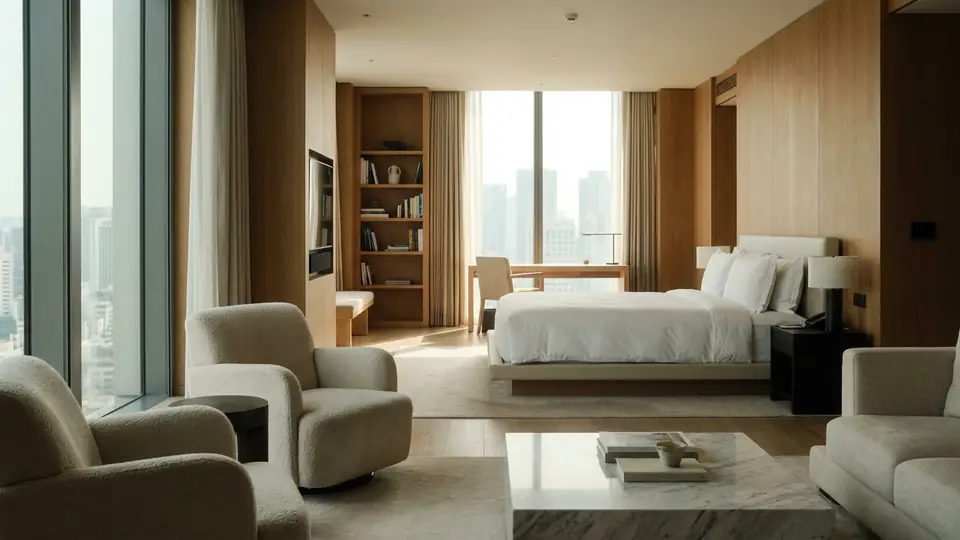
The door opens. The curtains are irrelevant. The far wall of the suite is glass.
Floor Thirty-Five
The terrace door pushes back when you open it. Not a breeze, not a draft. Wind, steady and flat, the kind that has been traveling across the city with nothing to stop it at this height. It finds your hair and rearranges it. It arrives at your terrace with the force of something that lives up here and tolerates your visit.
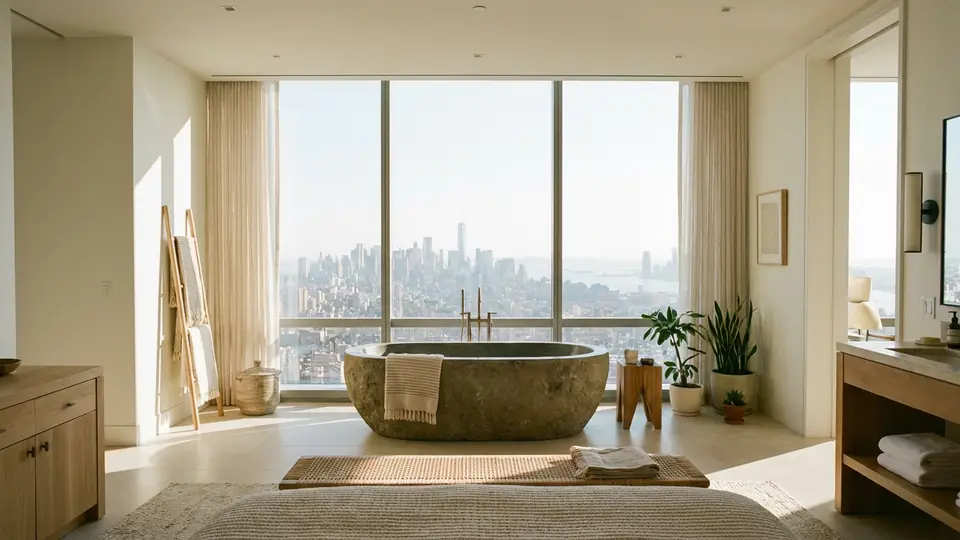
Glass panels shield the tub on three sides, breaking the wind into eddies without blocking the view. Someone designed this for this altitude, knowing that without the panels the water would cool faster than the heater could compensate. You turn the jets on. The steam rises and the wind catches it immediately, pulling it sideways in a long streak that vanishes over the railing and into the dark.
The water is hotter here, or it feels hotter, because the air around it is cooler. Thirty-five floors up, the temperature is three or four degrees lower than the street. You do not think about this in numbers. You think about it as the feeling of your shoulders above the waterline: cool and tight, pulling you deeper, urging you to sink until the heat covers everything.
The streets you walked this afternoon have been replaced by a light field. A flat, glittering plane that extends to every horizon, interrupted by dark patches that might be parks or rivers and bright channels that might be highways or districts. You cannot see people. You cannot see cars, not as objects. You see movement, the aggregate flow of a million decisions rendered as light and direction, but the decisions themselves are invisible. The city at thirty-five floors is a time-lapse photograph. It looks like data.
There is nothing coming up from below. The horns you heard at floor eight, the ambient hum of floor twenty: gone. Wind and water. That is the entire soundscape. Wind moving past the glass panels, water circulating through the jets. If the city below is making noise, and it is, the distance has absorbed it so completely that it might as well be a projection cast on the inside of a dark dome.
This is what high altitude does to the two of you. It removes the subject. At floor eight, the city was the subject: you talked about it, pointed at it, narrated it. At floor twenty, the city was ambient: you watched it, felt its texture, let it hum beneath your silence. At floor thirty-five, the city is gone. Not literally. It is still there, enormous, luminous, pulsing with its data-light. But it offers nothing to discuss. There is no detail to point at. No weather approaching; you are inside the weather up here, the cloud layer close enough that the building's upper lights diffuse into mist.
What remains is the water and the person in it with you.
She is looking up. From here, looking up is more interesting than looking down, because down is abstract and up is close: stars, or the undersides of clouds lit orange by the city's glow, or the red pulse of an aircraft light crossing the sky slowly enough to track from one side of your vision to the other. You watch it together. You do not say what it is, because you both know, and because speaking at this altitude feels like effort the moment does not require.
The wind shifts and a curtain of steam crosses between you. For a second you cannot see her. Then the wind corrects and she is there, eyes closed, head against the rim, the city behind her reduced to a blurred luminance that frames her without competing. The tub at thirty-five floors is suspension. You are hanging above a city in hot water with someone, and the city has nothing to do with it anymore. The altitude has subtracted everything but the essential fact: two people, heat, wind, dark, sky.
Morning
It is early. The sky is the grey of a sky that has not decided what color it will be today. The city below, which was a light field six hours ago, is rebuilding itself in the dawn. You can see it happening. A bus, small as a fingernail, appears on a boulevard and begins its route. A jogger traces the edge of a park. A delivery truck idles at a loading dock, its hazard lights blinking with the first color of the day.
The water is still hot. The jets are off. The wind has died to something manageable, something that moves the surface in small, irregular waves but no longer pulls the steam sideways. The person beside you is awake but quiet, watching the same thing you are watching: a city assembling itself from parts. Streetlights click off in sections, east to west, as the sun does what the grid could not and organizes the city by light instead of geometry.
From up here, dawn is not a moment. It is a process. The buildings gain dimension; they were flat shapes against dark, and now they have depth, shadow, surface. Windows catch the early sun and throw it back at angles that change as you watch. The city is filling in. It is becoming the place you walk through in an hour, with its noise and its garlic and its faces and its specific, legible life.
You stay in the tub until the light turns gold. Then you get out. You dry off. You take the elevator down, and this time you watch the numbers descend: thirty-five, twenty, twelve, eight, lobby. The doors open to the sound of luggage wheels on marble, a phone ringing at the front desk, a child asking a question in a language you half-recognize. The street outside is bright and close and full.
You walk into it. The buildings are around you now, not below you. The sound is specific again: that bus, that horn, that conversation from an open window. You look up at the tower you just came from. You scan the upper floors, trying to find your balcony, your terrace, the place where you were in the water an hour ago watching this street wake up.
You cannot tell which one it was. The city has already taken you back.